About me
I am an Assistant Professor of Geometry (Professor Auxiliar) at the Department of Mathematics of the University of Porto.
Previously, I worked as a postdoctoral researcher at the QMATH Centre of the University of Copenhagen (with Matthias Christandl) and at Centrum Wiskunde & Informatica (CWI) in Amsterdam (with Monique Laurent). I received my doctoral degree from the Universität Konstanz, under the supervision of Markus Schweighofer.
My research applies techniques from algebraic geometry and semidefinite optimization to tensor problems. Tensor geometry has a rich scope of applications, including algebraic statistics, polynomial optimization and quantum information theory.
On the side of pure mathematics, I am interested in generic ranks and identifiability of secant varieties, and in algorithms for invariant tensor decomposition models.
 |
|---|
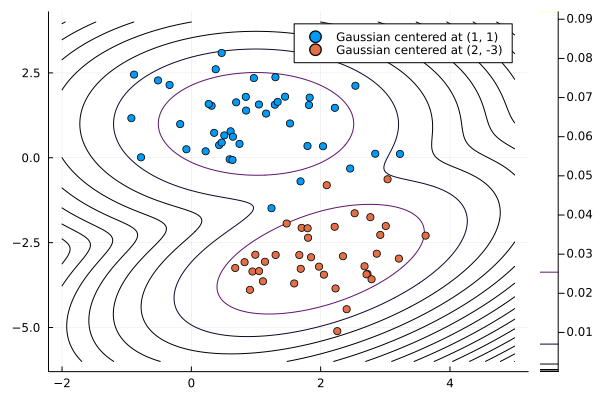
| Samples, which follow a Gaussian mixture distribution. |
On the side of applications, Gaussian mixtures have been a central theme in my research, and I am particularly interested in the problems of identifiability and parameter recovery for mixture distributions. It is particularly fascinating to me, how classical subjects of 19th and 20th century geometry, such as the theory of Waring decompositions and sum-of-squares representations, are applied in cutting-edge algorithms and recovery results for high-dimensional estimation problems.
Research highlight
My new preprint with Benjamin Lovitz is out! We prove that border rank = rank for Kruskal tensors. In the same work, we also establish a Kruskal theorem for alternating tensors. See the publications page for a list of my publications and preprints.